
Managing Personal Finances for Artists & Creative Entrepreneurs
By Chris James, Actor & Community Educator
I’ve always thought organization was an underrated skill. Some of my friends avoid calendars, thinking they get in the way of spontaneity; however, I’ve always believed that organization does not hinder spontaneity, it makes spontaneity easier.
Finances are no different. Having an organized budget helps you avoid overspending, and it facilitates spontaneity.
- “Can I afford a last-minute vacation?”
- “I could really go for some retail therapy.”
- “Tonight, I’m treating myself to a steak dinner.”
- “Impromptu wine and cheese night!”
Wouldn’t it be fantastic to do all of this within budget? To enjoy the thrill of spontaneity without the crash of credit card debt? An organized budget could very well be the missing piece to your best spontaneous life.
So why do so many of us resist using one? It’s rarely about finding the right app; those are a dime a dozen. The real challenge is fluctuating income.
Many artists and entrepreneurs feel a monthly budget isn’t useful to them because their income is unpredictable. But I guarantee three things:
- A simple budget is one of the best ways to ease financial stress and feel in control.
- The free spreadsheet we’re sharing is among the best out there – created by a fellow artist and entrepreneur!
- Mastering your budget can actually be fun, and it fuels more spontaneity by helping you track your monthly budget, debts, and savings goals.
The Curse of Fluctuating Income
Creating a monthly budget is easy with consistent income, but that’s rarely an artist’s reality. So the question is: how do you plan ahead? Our spreadsheet has space for:
- A) Recurring income – fixed amounts each month.
- B) Variable income – varying amounts of income month to month.
As you book work, you can add projected income to your variable, month-to-month income. Combined with projected expenses, you can quickly see:
- If you’ll meet your monthly expenses
- Whether you’ll have money to put towards savings goals
- “Do I have money for something spontaneous in July?”
You’ll have a clear view of your finances, and our charts will help you visualize it all at a glance.

Core Sections
The sheet itself helps in three core sections:
- Debt Calculation & Payoff Schedule
- Savings Goals & Savings Schedule
- Monthly Budgets & Transactions
Debt calculation is a huge help. Many people are afraid to tackle their debts because they don’t know how much to put toward their amounts owing. Paying enough to cover your monthly interest, a bit of the principal (the original debt amount), and still leaving enough money left over for expenses can be a daunting calculation. But the spreadsheet we are giving you today makes it incredibly simple. It’s as simple as…
- Knowing how much you owe
- Knowing how much you’ve already paid (it’s okay if it’s $0)
- And finding out your interest rate (% easily searchable)
…and that’s it! With that, you can figure out an easy schedule for repayment.
Savings goals might seem like luxuries when starting out, but small contributions add up fast. Just like our debt calculation, you’ll see how long a savings goal will take you based on the goal and interest rate.
Monthly budgets track recurring expenses in the monthly budget section, like rent, internet, phone, car insurance, etc. Additionally, this section provides a budget for variable expenses, such as groceries, restaurants, entertainment, and gas, among others.
When you start tracking your transactions, you’ll quickly see where your money actually goes. (Spoiler: probably not where you think.) Seeing those patterns helps you adjust before things spiral into debt territory.
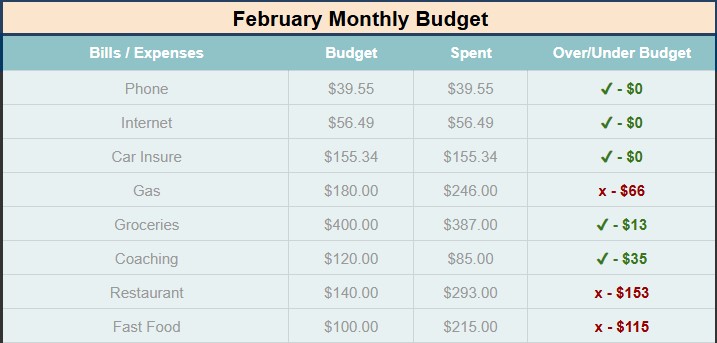
There’s even a section for month-specific expenses. Expenses like…
- Website renewals
- Annual subscription renewals
- And yearly dues payments
…so you can anticipate one-offs before they surprise you. All of this information works together to give you a complete picture of your financial health.
Common Mistakes
No one’s perfect. Keep an eye out for these pitfalls:
- Double-check your transactions. The easiest mistake is a simple typo. If totals don’t add up, double-check your entries.
- Infrequent updates. Waiting too long makes catching up tedious and error-prone.
- Forgetting to subtract the tax. If part of your income includes sales tax (HST/GST), consider adding a month-specific expense of sales tax (e.g. February HST) so that you have an accurate picture of how much money you actually have to use from your income.
Good Habits
Now that we have pitfalls to watch out for, let’s sprinkle in some good habits.
- Rainy day fund. If you have even $1 after budgeting for your bills & expenses, please start at least one savings account for a rainy day. Things go wrong, surprises come up, and having even a little money to put toward a surprise expense can save you from amassing unnecessary debt.
- Review your sheet month to month. Look for patterns – where do you overspend? Where do you save? The answers will help you tweak your habits and reach your goals faster.
- Create a routine. Like James Clear says in Atomic Habits, “We don’t rise to the level of our goals; we fall to the level of our systems.” Set a five-minute ritual once or twice a week to update your spreadsheet. Even on low-energy days, your routine keeps you grounded.
Bringing It All Together
No one’s expecting perfection. The goal isn’t to become an overnight financial wizard; it’s to practice. Consistency leads to clarity, confidence, and control.
Step by step, it all comes together.
Because here’s the secret: you don’t conquer mountains in a single leap; you climb them one steady step at a time. And before you know it, you’ll be standing at the top, debt shrinking, savings growing, and living your best spontaneous life.
Meet Chris James
Chris James (he/him) is an actor, educator, and entrepreneur dedicated to uplifting his community. With a strong entrepreneurial spirit, he shares his expertise through four dynamic workshops and teaches financial literacy in colleges and universities, while also developing an animated series to make these concepts more accessible. Alongside his teaching and creative work, Chris manages a charity initiative, using his drive and resourcefulness to foster financial literacy and create meaningful change in the community.